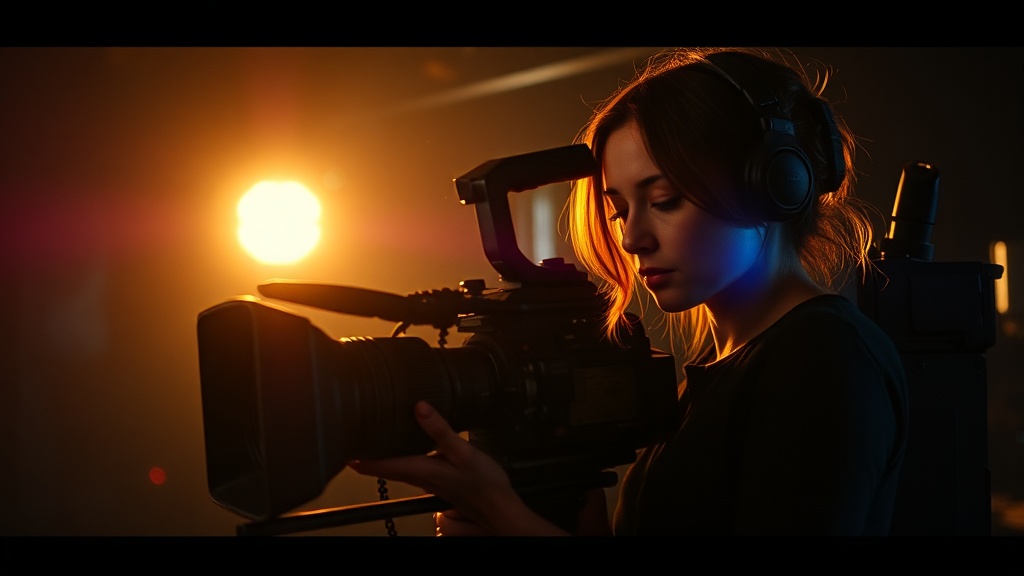
She Built Every Frame You Loved. You Just Don't Know It. (March 2026)
Vibe Check: IWD is Sunday. The ReFrame report drops this month. And I keep watching extraordinary-looking films where nobody mentions the name of the person who actually built the images. Let's fix that.
Let's talk about the person who actually built the thing everyone's praising.
Not "the director's vision." Not "breathtaking visuals." The human being who designed the light, operated the lens, made the image that landed in your chest at 2 AM when you couldn't sleep and put on something old and felt something.
Here's the pattern: a film looks extraordinary. Critics call it "Villeneuve's stark beauty" or "Fukunaga's hypnotic rhythm." Nobody says the DP's name. Nobody says the editor's name. The director gets the noun; everyone else gets the passive voice.
This isn't always deliberate. Cinema has a century-old auteur attribution problem — the director-as-sole-author mythology that flattens every frame into a single creative vision. But when the person holding the camera is a woman, when the person cutting the timeline is a woman, when the person building the world the film inhabits is a woman — the erasure lands differently. Because there's a track record now. And it points in one direction.
The Frame Problem
Rachel Morrison shot Mudbound in 2017. She was the first woman ever nominated for the Academy Award for Best Cinematography in the award's entire history. Entire history. The Oscars have existed since 1929. That's 88 years before a woman was nominated for the craft of making images.
She didn't get the statue. Blade Runner 2049 did, which — fine, it's a beautiful film. But Morrison's work on Mudbound is extraordinary. Low, natural light. Soil-level compositions. A visual language that puts you in the mud, in the heat, in the specific texture of that American grief. That's not "the director's vision." That's a DP choosing a lens, choosing a stop, choosing where to put the camera so that the light from a window hits a face exactly right.
Alice Brooks shot In the Heights — meticulous, vibrant work that earned zero cinematography conversation because the film's reception got complicated by other things. Rina Yang has been building a reel that cinematographers twice her age are studying. These are people doing the thing — drawing the light, constructing the image, making the technical decisions that make a scene feel the way it feels.
The ReFrame/SDSU data on the top 250 films (most recent report available as of early 2026) says women hold 23% of key creative roles — directors, cinematographers, editors, producers, writers combined. Break out cinematography specifically and the number is worse. But you wouldn't know it from the bylines or the awards attention or the profile pieces in American Cinematographer.
The Editing Invisibility
Editing is the most invisible craft in cinema. Most audiences don't have a mental model for what editors actually do, which means they don't notice when it's exceptional and don't look for who did it. I've written before about how dialogue mixing disappears until something goes wrong — editing is the same deal, except the stakes are even higher because it's not just legibility, it's whether the whole thing coheres.
Here's what editors do: they determine whether a scene works. Not the director. Not the writer. The editor. The timing of a single cut — one frame earlier or later — is the difference between a punchline landing and dying. The decision to cut away from a face before the emotion peaks versus holding until it breaks — that's the editor. Every scene you've ever described as "I don't know, it just felt right" was that way because someone made forty decisions per minute in a dark room and all of them were right.
Thelma Schoonmaker has been cutting Scorsese's films since Raging Bull. She has three Oscars. Schoonmaker is a household name to cinephiles, but ask a casual moviegoer who cut Goodfellas and watch them stare. She's the exception in terms of recognition — not the rule. For women editors without Scorsese as a career-long collaborator, the path to visibility is even narrower.
The problem isn't just credit. The problem is that when editing is invisible, no one develops vocabulary for praising it. So when a female editor's work is exceptional, there's no cultural infrastructure for recognition. The film "flows well." The performances "feel real." The pacing "never drags." Nobody says: someone built that with a timeline and a monitor and ten thousand decisions you'll never consciously register.
The World That Was Built Before You Got There
Production design is the third leg of this argument and the one that makes me most frustrated when I hear someone praise a film's "atmosphere."
The atmosphere was built. By a human. Using a budget, a construction crew, a paint department, and an architectural understanding of how physical space shapes how characters move through it. When you feel the weight of the world in a film — when a hallway feels long, when a room feels wrong, when a landscape feels like it has memory — a production designer made those decisions. Before the camera rolled. Before the director said action.
Tamara Deverell's work on Nightmare Alley built a world so specifically corrupted that the rot felt structural — not directed into existence, but in the rooms, in the surfaces, in the light that had nowhere clean to land. She received an Academy Award nomination for it. Ruth De Jong designed the architecture of Nope's Haywood Ranch into something that felt like it had existed for decades before the shoot. The alien threat in Nope lands partly because the world it invades feels real, and that realness starts with production design — with someone deciding what wood looks like after twenty years of California sun.
These are not decorators. They are architects of the film's physical reality. When we attribute that reality to "the director's vision," we're not being imprecise — we're being wrong.
The Math Doesn't Lie
23% across key roles on the top 250 films. Let me put that in terms that are easier to feel: if you watched the ten biggest films last year, roughly two of them had a woman in a key creative role. The other eight did not.
That's not a pipeline problem. That's not "we just need time." The talent is there. Morrison shot Black Panther — the highest-grossing solo superhero film in history at the time of its release. Brooks shot In the Heights. Yang is building a body of work that should be getting the Deakins treatment in the press. The women are doing the work. The system is making the decisions about who gets seen, credited, hired, and celebrated — and it is making those decisions badly, consistently, for decades.
ReFrame's FYC push this awards season is trying to fix the visibility end of this. Getting voters to actually watch films with women in key craft roles, getting nominators to look at the DP reel and not just the director's name. It's a bandage on a structural problem, but it's the bandage that currently exists.
Why I'm Saying This
Look, I've written a lot about craft on this site. About how dialogue mixing is the invisible design behind whether a scene is legible. About how the LED wall is creating a texture problem that actors can't work around. About how frame rate is a decision that shapes performance. All of it comes from the same place: the belief that cinema is made by craftspeople, not auteurs, and that understanding what those craftspeople actually do makes you a better, more honest viewer.
The auteur myth has always been a simplification. But it's a simplification that benefits whoever fits the dominant archetype — and that archetype has been male for the full history of the medium. When a male DP becomes a household name, it happens because the culture has a category for it: the technical visionary. When a female DP does the same work, there's friction. The category doesn't fit as cleanly. The profile piece is harder to pitch. The award nomination takes longer, if it comes at all.
Technical excellence isn't gendered. Light does what light does regardless of who's positioning the bounce card. A cut lands or it doesn't based on timing, not the editor's biography. A room feels right or it doesn't based on the production designer's choices, not their name.
The work doesn't change based on who's holding the camera. The industry's just been slow to notice.
See you in the front row.