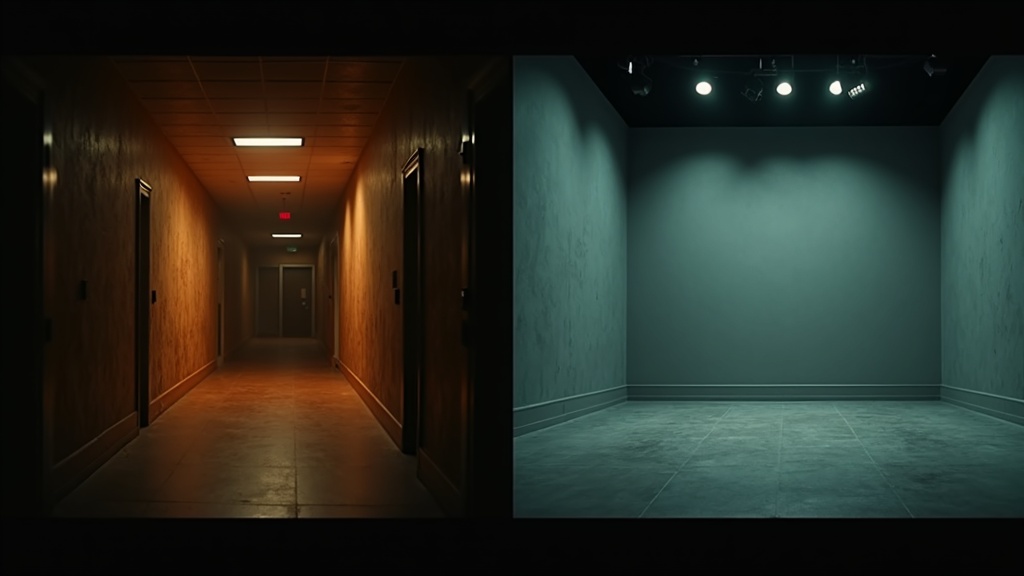
The Volume is Stealing Your Movies: Why LED Stages Are Making Blockbusters Look Like Mud

Vibe Check: You know that feeling when you walk out of a $200 million superhero movie and something feels… off? The explosions were big, the quips landed, but the whole thing felt like watching someone else play a video game? That’s not your imagination. That’s The Volume. And it’s killing the texture of modern cinema.
The Projection Booth Revelation
Let me take you back to last Tuesday, 11:47 PM. I’m in my usual seat at the Music Box — third row center, where the screen wraps around your peripheral vision like a hug. We’re watching a 35mm print of Thief (1981, Michael Mann, 2.35:1 aspect ratio, for the record). The opening sequence: rain-soaked Chicago streets, neon reflecting in puddles, actual sodium-vapor street lamps painting everything in that impossible amber that you can’t color-grade your way into.
I leaned over to the guy next to me — total stranger, hadn’t said a word all night — and whispered: "Are we seeing this?"
He nodded. Didn’t need to say anything else.
That’s what movies used to feel like. Physical. Weighted. Like you could reach out and touch the humidity in the air.
Now? I walk into a multiplex for the latest Marvel/DC/Star Wars/Insert-IP-Here and I’m looking at… gray. Flat, even, boring gray. And it’s not the cinematographer’s fault. It’s not the colorist’s fault. It’s The Volume.
What The Volume Actually Is (And Why It Sounds Cool)
Look, I get why filmmakers got excited about The Volume. I really do. It’s essentially a giant LED soundstage — a wraparound wall of high-resolution screens that can display any environment in real time. Need an alien planet? Boom, there it is. Need 1920s New York? Done. Need a spaceship interior with stars whipping past the windows? No green screen required.
(Check the behind-the-scenes on The Mandalorian — that’s where this tech went mainstream. And in fairness, that first season looked pretty good. Revolutionary, even.)
The pitch is perfect: actors can actually SEE the environment they’re supposed to be in, which helps their performances. No more staring at a tennis ball on a stick pretending it’s a dragon. Natural reflections in eyes and armor. Dynamic lighting that changes with the scene.
On paper? It’s a cinematographer’s dream.
The Reality: Why Everything Looks Like a Zoom Call
But here’s the pivot, and I need you to look at this with me: The Volume has become a crutch, not a tool.
The problem isn’t the technology itself. It’s how it’s being deployed across the entire industry. Here’s what’s actually happening:
1. The Lighting is Lying to You
Real locations have what cinematographers call "motivated light" — light that makes sense. The sun comes from a window. Street lamps cast amber pools. Fire flickers and dances. These light sources have character.
LED walls emit a flat, even, omnidirectional glow. Even the best ones. It wraps around actors in a way that feels slightly… digital. Slightly wrong. You might not consciously notice it, but your eye does. (Your brain has spent millions of years evolving to read natural light. It knows when it’s being faked.)
2. The Depth is an Illusion
The Volume excels at mid-ground. Put your actors ten feet from the LED wall and it looks pretty convincing — for a medium shot. But try to get depth of field that extends past that wall? Try to have a character walk toward a distant horizon?
You can’t. Because there is no distant horizon. There’s a wall. So every shot becomes flat. Layered, maybe, but flat. No atmospheric perspective. No haze catching the light. Just… screens.
3. The Color Space is Compromised
Here’s where I get really technical for a second, because this matters. LED walls operate in a specific color gamut and brightness range. They can’t push pure blacks (because they’re literally emitting light). They struggle with true saturation. And when you try to color-grade footage shot on The Volume, you’re grading digital footage of digital footage.
It’s like making a photocopy of a photocopy. The texture degrades.
The Proof is on the Screen
I’m not just being a grouch here. Let’s look at some recent examples:
Ant-Man and the Wasp: Quantumania (2023): Entirely shot on The Volume for the Quantum Realm sequences. And it looks like… a screensaver. Every surface has the same diffuse reflectivity. The "distance" feels like a backdrop at a theme park. (Compare this to the practical sets of the first Ant-Man — night and day.)
The Flash (2023): Oh boy. That infamous scene where Michael Keaton’s Batman stands in front of a clearly digital backdrop? That’s The Volume pushed past its breaking point. The lighting on his face doesn’t match the "environment." The shadows fall wrong. It’s not just bad — it’s instructively bad. It shows you exactly what’s missing.
The Mandalorian Season 3: Even the show that pioneered this tech started looking worse as they leaned harder into Volume stages. Compare the Season 1 finale (practical set, real location work) to Season 3’s increasingly digital-looking planets. The texture is just… gone.
The Alternative: Give Us Dirt, Give Us Reality
I want to be clear about something: I’m not saying we should go back to shooting everything on a backlot with painted backgrounds. (Though honestly? A good matte painting has more soul than a bad LED wall. Fight me.)
What I’m saying is this: The best-looking movies of the last few years were the ones that either avoided The Volume entirely or used it sparingly.
Look at Dune: Part Two (2024). Denis Villeneuve shot on location in Jordan and Abu Dhabi. Real sand. Real sun. Real atmospheric haze that no LED wall can replicate. The scale feels enormous because it is enormous. When the sandworms rise, you feel the heat coming off the screen. (That’s not a metaphor — you actually do. Practical location shooting captures subtleties that digital stages flatten out.)
Or Mission: Impossible – Dead Reckoning. Tom Cruise jumping off a cliff on a motorcycle? That’s real. The train fight? Built practically. And it shows. Every frame has weight, danger, presence. You can’t fake physics with LEDs.
Even Oppenheimer — yes, I know, we’re all tired of hearing about it — but look at the Trinity test sequence. Christopher Nolan wanted to recreate a nuclear explosion without CGI. So they built practical rigs, used miniatures, shot on large-format film. The result? Texture. Chaos. Unpredictability. The light behaves in ways that no pre-programmed LED array could anticipate.
The Business Reality (And Why We’re Stuck)
I know what you’re thinking. If The Volume looks worse, why does everyone use it?
Two words: control and cost.
Studios love The Volume because it eliminates variables. No weather delays. No location permits. No golden hour race against the sun. You can shoot "exteriors" at 3 AM if you want. You can change the background between takes. It turns filmmaking into a factory process — predictable, efficient, and completely soulless.
And for streaming shows that need to churn out 8-10 episodes on a brutal schedule? I get it. The Volume is a survival tool.
But for theatrical features? For movies that want to be "events"? We’re accepting a massive downgrade in visual quality for the sake of convenience. And audiences are noticing, even if they can’t articulate why.
The Call: Demand Better (And Vote With Your Eyeballs)
Here’s where I land on this: We don’t have to accept the gray.
When you see a movie that was clearly shot on location, that has texture and weight and atmosphere — support it. Tell your friends. Buy the ticket. Show the studios that we notice the difference between Dune and Quantumania.
And filmmakers: I’m begging you. The Volume is a tool. Use it like one. For backgrounds that would be impossible otherwise. For quick pickups. For specific VFX integration. But please — give us a real sky sometimes. Give us practical sets. Give us actors walking through actual spaces with actual light bouncing off actual surfaces.
The texture is worth it. The texture is everything.
Next week: I’m diving into the "Bitrate Betrayal" — why your 4K streaming copy of a movie is lying to you about its actual resolution. Bring your calculators.
See you in the front row.