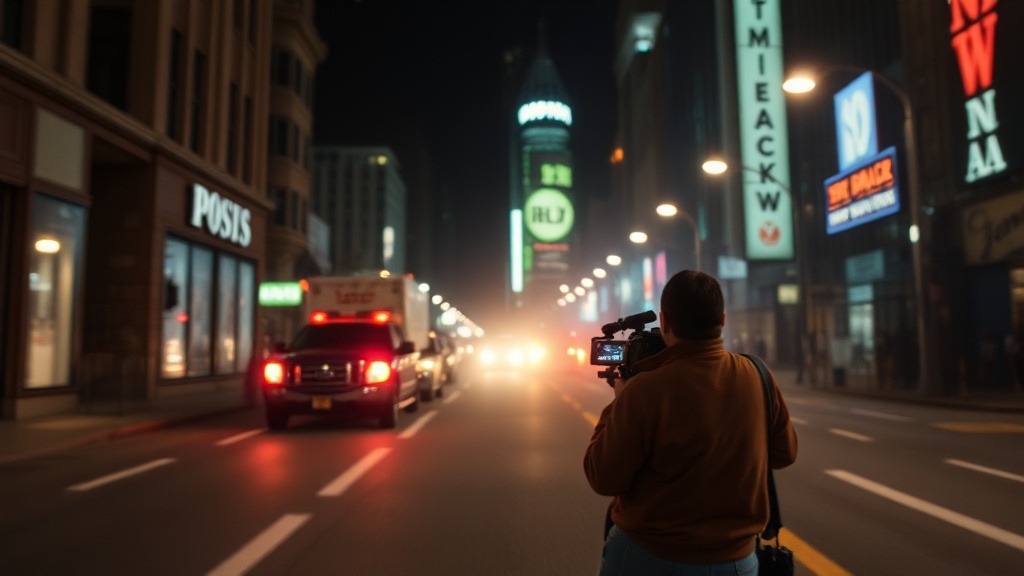
Why Does the Camera Float Through Some Scenes But Stay Locked in Others?

Have you ever found yourself leaning forward in your seat during a conversation scene—your body tense, breath held—without quite understanding why? The actors aren't shouting. Nothing's exploding. Yet your nervous system is firing like you're in danger. Nine times out of ten, the culprit isn't the performance or the score. It's the camera. Specifically, it's whether that camera is locked down like a surveillance feed or breathing with the scene like a living thing.
After fifteen years in projection booths—threading 35mm prints, adjusting lamphouses, watching the same films projected hundreds of times—you start noticing the mechanics beneath the magic. You see how a dolly move that took six hours to set up creates a sensation that no amount of acting can manufacture. Camera movement is the hidden grammar of cinema. It operates below conscious perception, but it shapes how we feel about every single frame.
Why Do Directors Choose Handheld Over Tripod Shots?
The shaky-cam debate has raged since The Blair Witch Project made audiences physically ill in 1999, but the technique predates digital by decades. The French New Wave pioneered it in the 1960s—shooting on the streets of Paris with lightweight Éclair cameras, breaking the formal rigidity of studio filmmaking. The difference between a locked-off tripod shot and handheld work isn't just aesthetic preference. It's a fundamental statement about reality.
When a camera sits on sticks (industry slang for tripod), it declares its own artificiality. The frame is stable, composed, deliberate. This works beautifully for Wes Anderson's diorama-like worlds or Stanley Kubrick's geometric precision—environments where human chaos intrudes on architectural order. But when Paul Greengrass shoots a Bourne film with handheld cameras, he's doing something else entirely. The micro-movements—those slight vertical bobs that follow an operator's breathing—mimic how our eyes actually experience stressful situations. Your vision doesn't stabilize when you're running. It jitters, hunts, loses focus.
The technical term here is "apparent subjectivity." Handheld camera work signals that we're seeing the scene through someone's eyes—or at least through a consciousness that exists within the scene's physical space. This is why found-footage horror works despite its narrative contrivances. The camera movement creates a contract with the viewer: this wasn't manufactured, this was recorded. Even when we know it's fiction (we bought a ticket to a movie, after all), our lizard brains haven't agreed to the illusion.
But there's a spectrum of handheld quality that separates professionals from amateurs. The best operators—think Emmanuel Lubezki's work in Children of Men—control the chaos. The frame still composes itself. Vertical horizons stay mostly vertical. Compare this to the early 2000s action trend of shaking the camera so violently that choreography becomes incomprehensible (looking at you, Quantum of Solace). One creates visceral immersion. The other creates visual noise.
What Does a Slow Dolly Reveal That a Static Shot Can't?
If handheld work brings us into the scene, the dolly shot—or track, or crane, or any camera movement that doesn't involve human instability—does something more subtle. It directs attention. It creates hierarchy. When a camera moves slowly toward an actor's face, it's performing the psychological act of noticing.
Consider the famous dolly-in on Ryan Gosling's face during the pawn shop scene in Drive. The camera starts wide, establishing the space, the fluorescent lighting, the mundanity of the transaction. Then, almost imperceptibly, it begins to float forward. By the time the violence erupts, we're already inside Gosling's head—because the camera has physically moved us there. This is what critics mean when they talk about camera movement as "psychological penetration." The lens isn't just getting closer; it's revealing interiority.
The mechanics here matter. A dolly-in changes spatial relationships differently than a zoom. When you zoom in, the background compresses but the perspective stays flat. When you dolly forward, the background shifts, objects pass through the frame, the three-dimensionality of space becomes palpable. Our brains process these cues differently. A zoom feels like scrutiny—sometimes aggressive, sometimes clinical. A dolly feels like approach—sometimes intimate, sometimes threatening.
Roger Deakins, arguably the greatest living cinematographer, uses slow dollies the way a composer uses crescendos. In Blade Runner 2049, the camera drifts through K's apartment during his most vulnerable moments—not cutting, not repositioning, just floating. The movement creates a sense of surveillance, of being watched by something impersonal and technological, which perfectly mirrors the film's themes of artificial consciousness and manufactured memory. You can read more about Deakins' philosophy on camera movement at his personal website where he discusses how mechanical movement creates emotional rhythm.
How Does Camera Movement Vary Across Different Genres?
The unwritten rules of camera movement form a language that we've all learned to speak without knowing the vocabulary. Horror films deploy slow, creeping dollies during their quiet moments—the camera sliding down hallways like a predator stalking prey. This creates anticipatory dread because we've been conditioned to understand: when the camera moves independently of characters, something is watching. Something is coming.
Romantic comedies, conversely, often keep the camera static or use gentle, flowing movements. Think of the classic two-shot where lovers talk on a park bench. The camera might barely drift with the wind in the trees, creating a sense of timelessness, of the world falling away. The movement says: nothing else matters right now. This is why the "whip pan"—that rapid horizontal swivel—feels so jarring when it appears in romance. It breaks the bubble.
Action cinema has its own grammar, one that's evolved significantly with technology. The Steadicam—introduced in the 1970s—allowed for smooth movement through impossible spaces. Films like Goodfellas (the Copacabana tracking shot) or Casino Royale (the parkour chase) use this tool to create continuous spatial coherence. We understand where we are in relation to the action because the camera never cuts. Compare this to the rapid-fire editing of contemporary blockbuster fight scenes, where twelve cuts in ten seconds disorient us rather than clarify.
The most interesting contemporary work often comes from cinematographers who understand genre expectations well enough to violate them. In The Witch, Jarin Blaschke uses almost entirely static compositions for a horror film—creating a sense of Puritanical rigidity that makes the supernatural elements feel more transgressive. In Moonlight, James Laxton combines fluid handheld work with sudden stillness, mirroring the protagonist's shifting relationship with his own identity. These aren't arbitrary choices. They're mechanical decisions that create emotional effects. For deeper technical analysis of how cinematographers make these choices, American Cinematographer magazine publishes detailed breakdowns of specific shots and sequences.
What separates competent filmmaking from great filmmaking often comes down to this: does every camera movement earn its place? The projection booth taught me that audiences feel lazy camerawork even when they can't articulate it. When a camera drifts without purpose, when it shakes without motivation, when it cuts instead of moving (or moves instead of cutting), we sense the machinery. We feel the hands of the filmmaker instead of disappearing into the world they've created.
The next time you watch a film, try this: notice when the camera moves. Ask yourself what would be lost if it stayed still—or vice versa. Would the confession scene lose intimacy? Would the chase scene lose urgency? The camera is never neutral. It's always choosing what to show us, when to show us, and how close we should be. That floating movement toward an actor's face isn't just technique. It's the machinery of empathy, calibrated to the millimeter. For more on the technical craft of visual storytelling, check out the resources at No Film School where working cinematographers break down their approaches to camera movement and composition.