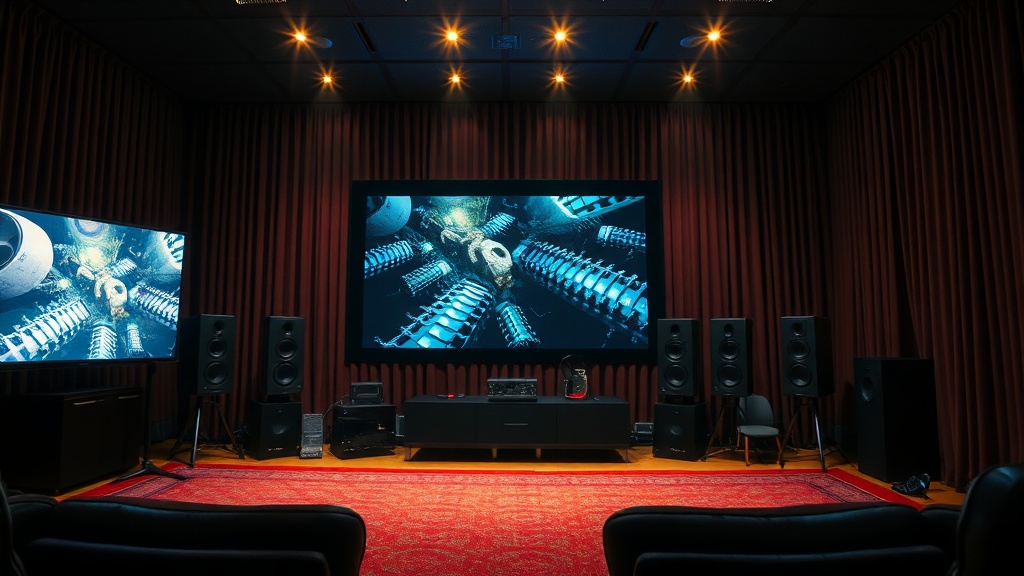
Why You Should Watch Movies with a Proper Sound System

A viewer sits on a couch, staring at a high-end 4K OLED television. The visual fidelity is staggering; the blacks are deep, the colors are vibrant, and the HDR peak brightness is hitting its marks. However, during a pivotal dialogue scene in a psychological thriller, the subtle rustle of a character's clothing is lost, and a low-frequency hum from a passing car outside the house drowns out the tension-building score. The visual experience is perfect, but the emotional connection is severed because the audio is thin, flat, and lacks spatial depth. This post explains why high-quality audio is not just a luxury, but a fundamental requirement for understanding the technical language of cinema.
The Architecture of Sound in Modern Cinema
Film is a dual-sensory medium. While the eyes process the frame, the ears process the environment. In professional cinema, sound is layered into three distinct categories: dialogue, sound effects (SFX), and the musical score. A proper sound system ensures that these layers do not bleed into one another in a way that creates "sonic clutter."
When you watch a film through standard built-in TV speakers, you are essentially listening to a collapsed version of the original mix. TV speakers are physically incapable of reproducing low-frequency sounds (sub-bass) and lack the dynamic range required to transition from a whisper to an explosion without clipping or distortion. This lack of range destroys the "dynamic headroom" that sound designers work so hard to create. If a scene relies on a sudden, jarring silence to build dread, but your speakers have a constant floor of background hiss or electronic hum, the intended psychological impact is completely neutralized.
The Importance of Dynamic Range
Dynamic range refers to the ratio between the quietest and loudest sounds in a piece of media. In a film like Dunkirk, Christopher Nolan uses a relentless, high-frequency Shepard tone to create anxiety. This sound oscillates between high and low pitches, creating a sense of constant rising tension. If you are using a basic soundbar or laptop speakers, you won't hear the subtle shifts in the low-end frequency that drive that anxiety. You will only hear the loud parts, making the experience feel one-dimensional and exhausting rather than immersive.
Spatial Awareness and the 360-Degree Soundstage
Modern films are mixed for multi-channel environments. Whether it is a 5.1, 7.1, or the more recent Dolby Atmos, the goal is to place the viewer inside the world of the film. This is known as "spatial audio." Sound is not just something that happens "in front" of you; it is an object that moves through a three-dimensional space.
Consider a scene in a sci-fi epic like Blade Runner 2049. As a spinner flies overhead, the sound should travel from the rear-left, arc across the ceiling, and descend into the front-right. With a standard stereo setup, that sound is simply panned left and right. You lose the verticality and the sense of scale. A dedicated surround sound system uses discrete channels to tell your brain exactly where an object is located in relation to your body. This spatial accuracy is what allows a director to direct your attention even when you aren't looking directly at the source of the sound.
- Center Channel: This is the most critical component for dialogue. It ensures that voices remain anchored to the screen and don't get lost behind the music or explosions.
- L/R Front Channels: These handle the primary musical score and the broader soundstage.
- Surround Channels: These provide environmental cues, such as rain, wind, or footsteps behind the viewer, deepening the immersion.
- Subwoofer (LFE): The Low-Frequency Effects channel provides the physical sensation of sound, essential for feeling the weight of a cinematic moment.
The Technical Connection Between Sound and Visuals
Sound and visuals are not independent tracks; they are a singular, cohesive unit. The pacing of a film is often dictated by the rhythm of the sound design. If a director uses a slow, rhythmic beat to build tension, the visual cuts are often timed to those specific auditory cues. When the audio is muffled or lacks clarity, the viewer's ability to perceive these rhythmic patterns is diminished, which can make the editing feel "off" or disjointed.
This connection is particularly evident in films that rely heavily on atmosphere. For example, in many horror films, the absence of sound is a tool used to heighten the viewer's vulnerability. If your audio system cannot produce true silence—or rather, a very low noise floor—the "silence" will actually be filled with the electronic hum of cheap components, ruining the tension. This is why understanding how long takes and intense scenes work is also about understanding how the sound stays consistent throughout the duration of the shot.
Building Your Home Cinema Audio Setup
You do not need a professional studio to significantly improve your experience. You can approach this in stages, depending on your budget and the complexity of your living space.
Level 1: The High-Quality Soundbar
For those in smaller apartments or with limited space, a high-end soundbar with dedicated upward-firing drivers (for virtual Atmos) is a solid starting point. Look for brands like Sonos or Samsung that offer dedicated center channels. While it won't provide true discrete surround sound, it will vastly outperform built-in TV speakers by providing a dedicated channel for dialogue and a much better low-end response.
Level 2: The 5.1 Discrete System
If you have the room, a true 5.1 system (Front Left, Front Right, Center, Surround Left, Surround Right, and a Subwoofer) is the gold standard for entry-level home cinema. This requires an AV Receiver (AVR) to decode the signals. This setup allows for actual physical separation of sound, meaning you can truly feel a car driving behind you. This level of hardware allows you to appreciate the nuance in visual storytelling and emotional resonance because the audio is finally matching the intensity of the image.
Level 3: Dolby Atmos and Object-Based Audio
The pinnacle of consumer audio is Dolby Atmos. Unlike traditional channel-based audio, Atmos treats sounds as "objects" that can be placed anywhere in a 3D space. This often involves adding height channels (speakers in the ceiling or upward-firing speakers). This creates a "hemisphere" of sound, making the ceiling feel like it has disappeared, which is essential for modern blockbusters designed with this technology in mind.
Common Mistakes to Avoid
When setting up your system, many enthusiasts make mistakes that actually degrade the cinematic experience. Avoid these common pitfalls:
- Ignoring Room Calibration: Every room has different acoustic properties. A corner might boost bass, while a large window might reflect high frequencies. Use a calibration microphone (often included with receivers like Denon or Marantz) to run an automated setup. This adjusts the timing and volume of each speaker to account for your specific room.
- Over-reliance on the Subwoofer: It is tempting to turn the bass up to maximum, but this can "muddy" the mix. If the subwoofer is too loud, it will drown out the mid-range frequencies where human speech resides. The goal is to feel the bass, not be overwhelmed by it.
- Improper Speaker Placement: Do not hide your surround speakers behind heavy curtains or inside cabinets. Sound is a physical wave; if you obstruct it, you lose the high-frequency detail that provides directional cues.
Ultimately, cinema is an art form designed to engage the senses. When you prioritize a proper sound system, you are not just "buying more gear"—you are respecting the work of the sound engineers and directors who spent months perfecting every single decibel of the experience. Don't let a mediocre speaker stand between you and a masterpiece.