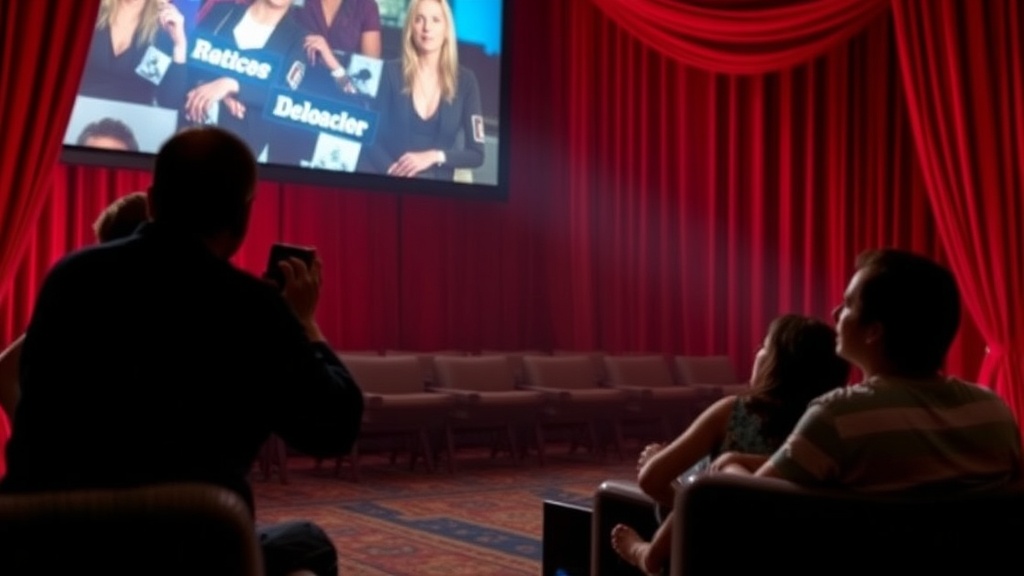
Curating Your Personal Film Festival: A Guide to Themed Movie Marathons

The Fallacy of the Random Shuffle
Most people approach a movie marathon with the mindset of a buffet: grab whatever looks good, pile it high, and hope for the best. They call it a "movie night," but a true curated film festival requires something much more rigorous than a random shuffle of Netflix trending titles. A successful marathon isn't just about watching several movies in a row; it is about constructing a cohesive narrative arc through the medium of selection. If you are simply watching three unrelated action movies back-to-back, you aren't hosting a festival—you are just succumbing to passive consumption.
A real festival has a thesis. Whether you are exploring the psychological descent of a protagonist, the evolution of a specific practical effect, or the visual language of a particular director, your selection must serve a central idea. When you move from a singular piece of art to a collection, you shift from being a spectator to being a curator. This distinction is what separates a mindless binge-watch from a transformative cinematic experience.
Step 1: Define Your Curatorial Thesis
Before you even look at a streaming service, you must define the "Why." A strong theme acts as the connective tissue that holds disparate films together. Without a thesis, your marathon will suffer from "tonal whiplash," where the emotional residue of one film makes it impossible to engage with the next.
There are three primary ways to structure your thesis:
- The Auteur Study: This focuses on the distinct visual and narrative fingerprints of a single director. Instead of just watching "good movies," you are tracing the evolution of a voice. For example, a Christopher Nolan marathon shouldn't just be his biggest hits; it should track his obsession with non-linear time, moving from the cerebral puzzles of Memento to the high-concept scale of Oppenheimer.
- The Technical Deep-Dive: This is for the cinephile interested in the "how" rather than just the "what." If you are fascinated by the tactile nature of cinema, you might curate a marathon around a specific technique. A perfect example would be a journey through the history of creature design, tracing the lineage from the stop-motion mastery in King Kong (1933) to the groundbreaking animatronics found in the evolution of practical effects.
- The Genre Deconstruction: This examines how a specific genre has been subverted or elevated over time. A "Neo-Noir" marathon might start with the hard-boiled aesthetics of Chinatown and end with the neon-soaked, synth-heavy landscapes of Blade Runner 2049, showing how the core tropes of the genre have been recontextualized for a modern audience.
Step 2: The Art of Sequencing (The Three-Act Structure)
A common mistake is treating a marathon like a checklist. In reality, you must treat your marathon like a single, long-form piece of cinema. This means applying a three-act structure to your programming. You need an opening that sets the tone, a middle that complicates or intensifies the theme, and a finale that provides a sense of resolution or profound impact.
The Opening (The Hook): Your first film should establish the "rules" of your theme. If you are doing a marathon on "Isolation in Space," start with something that establishes the psychological weight of the setting, such as Solaris (1972). This sets the intellectual baseline for your audience.
The Middle (The Expansion): The second and third films should push the boundaries of the initial concept. If the first film was about the feeling of a theme, the middle films should explore the mechanics or the consequences. If your theme is "The Cost of Ambition," and you started with Whiplash, your middle films should broaden the scope—perhaps moving to the cosmic scale of There Will Be Blood to show how ambition scales from the personal to the historical.
The Finale (The Climax): The final film is the most critical. It must be the "heavy hitter." This is the film that leaves the audience sitting in silence as the credits roll. It should be the most visually or emotionally taxing entry in your collection. If you have been studying the mastery of tension, your finale should be a masterpiece of sustained dread, like No Country for Old Men.
Step 3: Optimizing the Sensory Environment
A curated festival is a physical experience, not just a digital one. You cannot achieve a high-level cinematic immersion if you are watching a $300 television through a pair of cheap laptop speakers while sitting on a standard sofa. To truly honor the work of the filmmakers, you must address the technical environment.
Audio Fidelity: Sound is 50% of the cinematic experience. If you are hosting a marathon, the audio should be robust enough to handle the dynamic range of a modern score. If you aren't running a full 7.1 surround system, invest in high-quality hardware. Even a well-tuned soundbar for the budget-savvy cinephile can drastically improve the way you perceive spatial audio and dialogue clarity during a long session.
Visual Consistency: If you are jumping between a 1970s film shot on 35mm stock and a modern digital production, the shift in grain and color temperature can be jarring. If possible, calibrate your display settings for each era. For older films, you might want to slightly dial back the "motion smoothing" or "soap opera effect" found on many modern OLED and LED TVs, as this destroys the organic texture of film grain. Ensure your brightness and contrast settings are optimized so that the deep blacks of a noir film don't become a muddy grey mess.
Lighting and Atmosphere: Total darkness is the standard, but "controlled darkness" is the pro move. Use dim, warm-toned bias lighting behind your screen to reduce eye strain during multi-hour sessions. This prevents the "black crush" effect from being too taxing on your vision while keeping the focus entirely on the screen.
Step 4: The Logistics of Endurance
A marathon is an endurance event for both the viewer and the host. To prevent "viewer fatigue"—the point where the brain stops processing narrative and starts checking the clock—you must implement tactical breaks.
- The Intermission: Never skip the intermission. A 15-minute break between films is essential. This is not just for snacks; it is a mental reset. It allows the audience to discuss the previous film and prevents the "bleed-through" of one movie's mood into the next.
- The Menu: Avoid "heavy" foods that cause a glucose crash. If you are watching a three-film epic, you don't want your audience falling asleep during the second act because they ate a heavy pasta dish. Opt for high-protein snacks or light appetizers that can be eaten without looking away from the screen for too long.
- The "Palate Cleanser": If your marathon is particularly intense (e.g., a horror marathon), consider a "palate cleanser" short film between the second and third feature. A 5-to-10-minute animated short or a classic silent comedy clip can reset the nervous system before the final descent.
The Curator's Manifesto
Ultimately, a themed movie marathon is an act of respect. It is a way to say to the filmmakers, "I saw what you did there, and I want to see how it evolved." When you approach your living room as a temporary screening room, you elevate the act of watching a movie from a pastime to a study. Don't just watch movies; build a world, one frame at a time.
Steps
- 1
Define Your Central Motif
- 2
Select and Sequence Your Lineup
- 3
Design the Immersive Atmosphere
- 4
Prepare Themed Concessions